








The best Statsig alternatives & competitors, compared


Contents
In September 2025, OpenAI acquired Statsig and made founder Vijaye Raji its CTO of Applications. Then in May 2026, Amplitude announced a strategic partnership to take over Statsig's brand, platform, and customers, while the original team stayed at OpenAI.
For teams that chose Statsig for its rapid pace of innovation, that's reason enough to look around. Replacing it comes down to what you're optimizing for: fast, safe releases; deeper analytics; no-code web experimentation; or something else entirely.
Here's a breakdown of the best Statsig alternatives depending on your team's needs.
Which is the best Statsig alternative for startups?
PostHog: An all-in-one developer platform with product analytics, feature flags, experimentation, session replay, and more with a generous free tier and usage-based pricing. Trusted by over 60% of every Y Combinator batch and top startups like ElevenLabs and Lovable.
Eligible early-stage companies can apply to PostHog for Startups for $50,000 in additional credits.
Which is the best tool for enterprise governance and automation?
LaunchDarkly: Robust workflows, scheduling, auditability, and role-based controls. A strong choice if governance and automation are top priorities.
Which is best for engineering-led teams that want both flags and analytics?
PostHog: Combines feature flags with custom payloads (like JSON) and local evaluation and multivariate A/B/n testing with a full product analytics suite and session replay. Ideal for engineers who own experimentation and want to dive deeper into their results with fewer integrations.
Which is best for analytics-heavy PM and data teams?
Amplitude: Deep product analytics with integrated experimentation. Great when non-technical users need rich dashboards, reports, and insights alongside A/B testing.
Which is best for teams building AI features?
PostHog: Built for engineering teams shipping AI products. AI observability captures traces, spans, prompts, token costs, and latency across providers (Anthropic, OpenAI, Google, LangChain, and more).
Run evals with LLM-as-a-Judge to catch quality regressions, manage prompts directly in PostHog with versioning and fetch them at runtime (no redeploys), and use the prompt playground to compare models side-by-side.
Pair it with feature flags to roll out new models gradually, experiments to A/B test prompt variants, and session replay to see exactly what users saw when the model misbehaved.
Which is the best tool for marketers and no-code experiments?
Optimizely or VWO: Visual editors for web experimentation plus tools for personalization and campaigns. Great for marketing teams who want to run tests without engineering.
Which is best for self-driving product development?
PostHog: You can pair your experimentation efforts with PostHog Code, a desktop coding agent that runs on top of your product data. PostHog Code turns signals from your PostHog stack – recurring errors, frustration in session replays, survey responses, experiment results, etc – into a prioritized task list, then creates PRs with the obvious fixes.
It ships with PostHog skills so the agent already knows your stack, runs tasks in cloud sandboxes so they keep going after you close your laptop, and opens GitHub PRs you can review without leaving the app.
For more details, here are our in-depth comparisons of the best Statsig alternatives:
1. PostHog
- Founded: 2020
- Similar to: Statsig, Amplitude
- Typical users: Engineers and product teams


What is PostHog?
PostHog is an all-in-one developer platform for feature management, A/B testing, product analytics, session replay, AI observability, logs, and more. We also have a data warehouse to sync and query data from external sources and a customer data platform (CDP) to send data to destinations.
By combining all these tools into one platform, PostHog eliminates the need for stitching together integrations between third-party tools, and makes it easier for engineers to work with data. PostHog is popular with engineering-led companies, like AI startup ElevenLabs and Lovable.
Key features
A/B tests: Experiment in your app with up to nine test variations and track impact on primary and secondary metrics. Auto-calculate test duration, sample size, and statistical significance.
Feature flags: Rollout features safely with local evaluation (for faster performance), JSON payloads, and instant rollbacks.
Product analytics: Custom trends, funnels, user paths, retention analysis, and segment user cohorts. Also, direct SQL querying for power users.
Session replays: View exactly how users are using your site. Includes event timelines, console logs, network activity, and 90-day data retention.
MCP server: Connect Claude Code, Cursor, VS Code, Zed, and other MCP clients directly to your PostHog data so your AI agent can manage feature flags, query analytics, investigate errors, update prompts, and much more without leaving your editor.
How does PostHog compare to Statsig?
Statsig and PostHog are similar in some ways, but have different strengths.
PostHog offers more powerful product analytics and session replay features, including support for event autocapture, writing custom SQL insights, and session replay on mobile apps. It also supports a handful of feature flag features not available with Statsig and offers user surveys.
Statsig, as its name suggests, is an experimentation tool first and foremost. While both tools support core testing features, like secondary metrics and multivariate tests, PostHog doesn't offer multi-armed bandit or mutually exclusive experiments.
Main differences between PostHog and Statsig
- PostHog is fully independent and open source; Statsig was acquired by OpenAI and its brand and customers are currently operated by Amplitude.
- PostHog has a built-in data warehouse and SQL access on every plan; Statsig's warehouse-native mode is gated behind its Enterprise tier.
- PostHog offers an EU-hosted cloud at no extra cost; Statsig's hosted product is US-only.
- Statsig offers more advanced statistical methods (CUPED, sequential testing, multi-armed bandits); PostHog focuses on the core experimentation workflows.
Main similarities between PostHog and Statsig
- Both combine feature flags, experiments, and analytics in one platform.
- Both are built with engineering-led teams in mind.
- Both support secondary metrics and multivariate testing.
- Both offer usage-based pricing with a free tier.
Why do companies use PostHog?
According to G2 reviews, companies use PostHog because:
It's many tools in one: PostHog can replace Statsig (feature flags and A/B testing), Amplitude (analytics), and Hotjar (feedback and surveys). This simplifies workflows and ensures all product data is in one place.
They need a complete picture of users: PostHog includes every tool necessary to understand users and build better products. This means creating funnels to track conversion, watching replays to see where users get stuck, testing solutions with A/B tests, and gathering feedback with user surveys.
It's easy to get started: Many users love how PostHog's event autocapture means they can go from implementing its tracking code to ingesting events in just a few minutes. Enabling session replay is equally straightforward, so you can instantly start seeing how people are navigating your app or website.
Bottom line
PostHog is an ideal Statsig alternative if you're looking for a more powerful analytics tool that can also serve your A/B testing and feature management needs. It also offers a dedicated EU-hosted cloud at no extra cost – and, unlike Statsig, it's independent and open source.


Install PostHog with one command
Paste this into your terminal and make AI do all the work.

2. LaunchDarkly
- Founded: 2014
- Similar to: Harness, Kameleoon
- Typical users: Enterprise engineering and DevOps teams
What is LaunchDarkly?
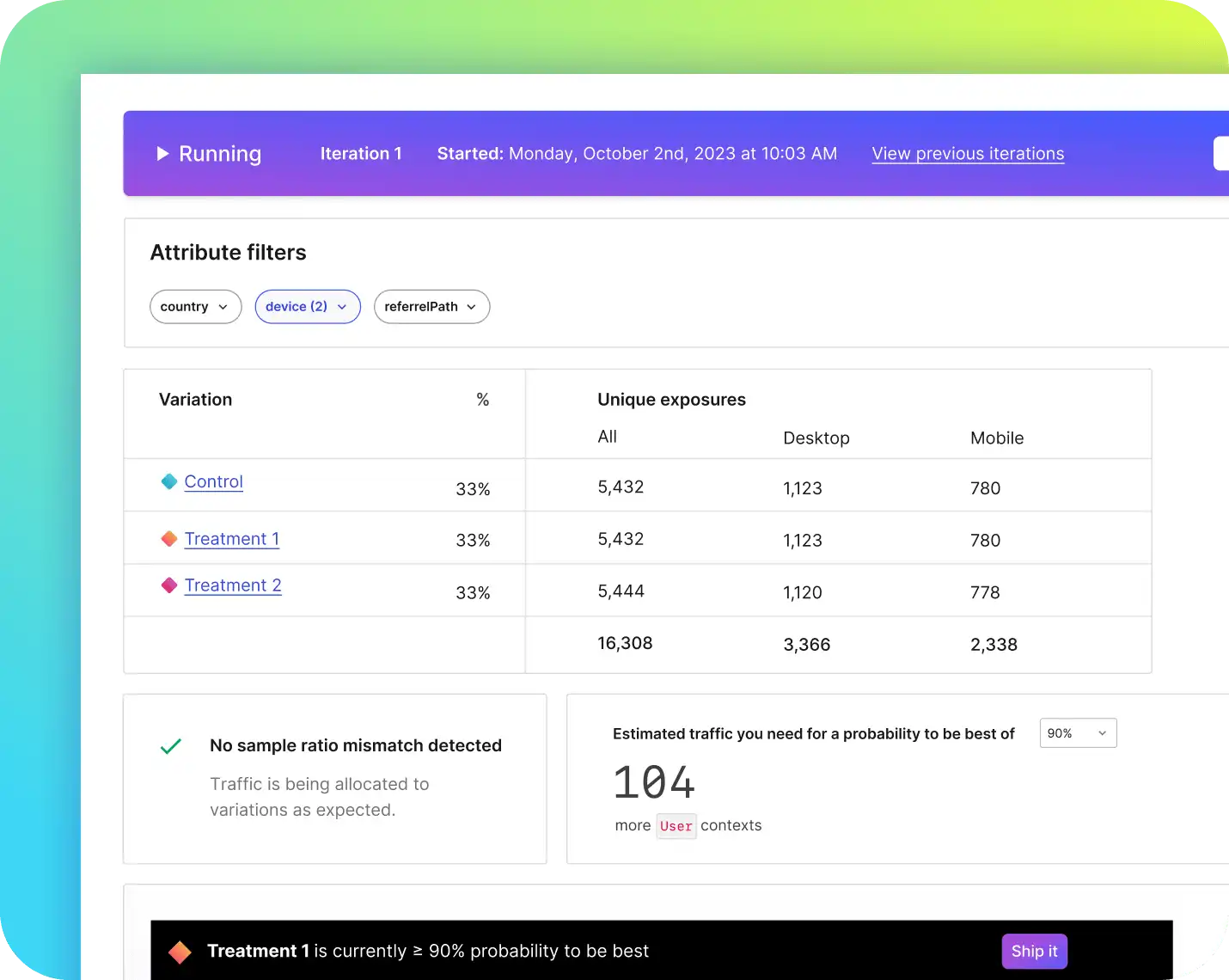
LaunchDarkly is an enterprise feature flag and A/B testing platform. It helps developers de-risk releases, target experiences, and optimize their products. It provides automation and governance features to ensure teams are following engineering best practices.
Key features
Feature flags: Control and target the release of features using multi-variate flags with real-time updates and local evaluation.
Experimentation: Run A/B/n tests against metric groups and segment. Easily roll out winning variants.
Automation: Advanced automations enable teams to not only schedule flag states, but do progressive rollouts and trigger workflows.
Governance: Audit flag changes. Get visibility into flag state across platforms. Use roles-based access controls to decide who can access and change flag states.
How does LaunchDarkly compare to Statsig?
LaunchDarkly and Statsig offer similar feature management and A/B testing features, though LaunchDarkly's lack of no code experiments and platform features might make it a less attractive option for non-technical users.
Main differences between LaunchDarkly and Statsig
- LaunchDarkly is seat-priced even on its free Starter plan (5 seats); Statsig gives every plan, including free, unlimited seats.
- LaunchDarkly goes deeper on enterprise governance, automation, and role-based access controls; Statsig is more experimentation-focused.
- Statsig offers no-code experiments and unlimited seats; LaunchDarkly is more developer-oriented and seat-based.
- LaunchDarkly is independent; Statsig is not.
Main similarities between LaunchDarkly and Statsig
- Both offer robust feature flagging with multivariate flags and local evaluation.
- Both support A/B/n experimentation with metric tracking.
- Both provide a wide range of SDKs for easy integration.
- Both are built primarily for engineering teams.
Why do companies use LaunchDarkly?
According to G2 reviews, users appreciate these aspects of LaunchDarkly:
SDKs: Reviewers appreciate how easy it is to integrate LaunchDarkly into their apps thanks to the range of SDKs they provide, like JavaScript, Python, Android, and iOS.
Automations: LaunchDarkly provides automations like scheduled rollouts, rollout templates, DevOps pipeline integrations, and stale flag cleanup.
Speed and availability: High uptime and speed are critical for developers. Reviewers highlight local caching and edge computing integrations as critical ways LaunchDarkly supports these.
Bottom line
LaunchDarkly is a good alternative if you desire more powerful feature management options compared to Statsig, though it doesn't offer some of Statsig's nice perks, such as unlimited seats and autocapture. Also, even though LaunchDarkly is working on product analytics and session replay, they are quite limited at the moment.
3. Amplitude
- Founded: 2012
- Most similar to: PostHog, Statsig
- Typical users: Product managers, data analysts, marketing teams
What is Amplitude?
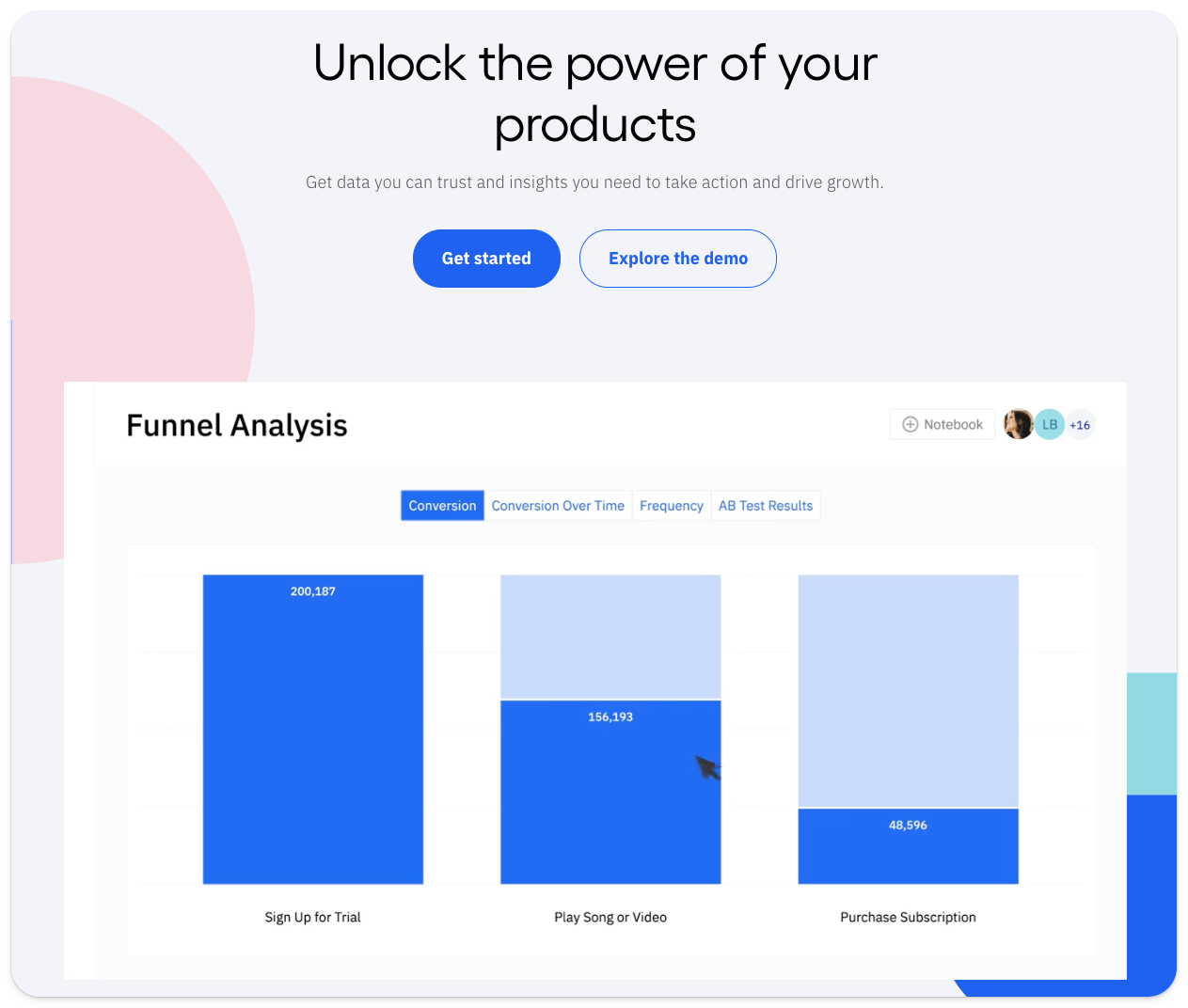
Amplitude was one of the original product analytics tools. Many large enterprise customers, like Ford, NBCUniversal, and Walmart rely on it. In recent years, it's also added A/B testing, feature flags, session replays, a customer data platform, and more, making it an obvious alternative to Statsig.
Key features
Product analytics: Funnel and retention analysis, user paths, behavioral cohorts, custom dashboards, and more.
A/B testing: Test new features on specific targets and analyze with primary, secondary, and counter metrics.
Customer data platform: Combine analytics data with third-party tools for data governance, identity resolution, and data federation.
AI insight builder: Generate insights based on natural language requests, like "What is my purchase conversion rate?"
How does Amplitude compare to Statsig?
Amplitude is missing some of the more complex statistical features of Statsig, but is very similar in terms of overall feature set.
Main differences between Amplitude and Statsig
- Amplitude has much deeper product analytics with funnels, cohorts, and user paths; Statsig's analytics are lighter and experimentation-focused.
- Statsig offers more advanced experimentation features like CUPED variance reduction and sequential testing; Amplitude's experimentation is more basic.
- Amplitude is independent; Statsig is owned by OpenAI.
- Amplitude is geared more toward product and marketing teams; Statsig leans toward engineers.
Main similarities between Amplitude and Statsig
- Both offer A/B testing, feature flags, and analytics in one platform.
- Both support warehouse-native analytics (Snowflake, BigQuery, Databricks).
- Both provide session replay alongside their core analytics.
- Both are trusted by large-scale companies running experiments at volume.
Why do companies use Amplitude?
According to G2 reviews, people like Amplitude because:
It's simple to use: Amplitude makes it easy for non-technical users to get insights about their product and make improvements. Amplitude is built for users like product managers and marketers, making it a popular choice for them.
It offers built-in A/B testing: Amplitude offers integrated experimentation features. This enables companies to run experiments on existing cohorts, and then analyze the data in a single place.
It helps them become data-driven: Amplitude users appreciate it helps them become data-driven. It becomes easy to add data, visualize it, and make decisions, and they can use it as a source of truth thanks to its built-in customer data platform.
Bottom line
Like PostHog, Amplitude is a good alternative if you value powerful analytics and experimentation in one, though it's less geared towards engineers than Statsig or PostHog.
4. Optimizely
- Founded: 2010
- Similar to: VWO
- Typical users: Enterprise marketing, frontend teams

What is Optimizely?
Optimizely is an all-in-one set of tools for marketing and product teams. It offers a combination of content management, marketing, web and feature experiments, and ecommerce optimization tools, all geared toward optimizing web experiences.
Key features
Web experimentation: Use Optimizely's visual editor and on-page previews to create frontend experiments quickly.
Feature experimentation: Run targeted experiments anywhere on your stack. View detailed reports on their impact.
Project management: Idea backlogs, workflows, and design tools to coordinate experiments and content.
Content management system: Manage, deliver, and optimize your content in a centralized location.
Ecommerce optimization: Customize checkout workflow along with CMS and experimentation to create the best possible commerce experience.
How does Optimizely compare to Statsig?
On paper, Optimizely is quite similar to Statsig, but it's more focused on marketing use cases, which is why it splits web experimentation and feature experimentation into two separate products. The former includes a no code, visual editor that's accessible for non-engineers.
Note: Although Optimizely was acquired by Episerver in 2020, they rebranded the combined company back to Optimizely in 2021.
Main differences between Optimizely and Statsig
- Optimizely is a full digital experience platform (DXP) with CMS, commerce, and personalization; Statsig is a focused experimentation and feature management tool.
- Statsig includes built-in product analytics and session replay; Optimizely relies on integrations with external analytics tools.
- Statsig is self-serve and free to start with transparent pricing; Optimizely is enterprise sales-led.
Main similarities between Optimizely and Statsig
- Both support advanced experiment configurations like multivariate tests, mutually exclusive experiments, and holdouts.
- Both have invested in AI tooling for experiment workflows in the last year.
- Both are owned by larger entities pursuing platform consolidation strategies.
Why do companies use Optimizely?
According to G2 reviews, people are fans of Optimizely because:
It's easy to use for non-engineers: Optimizely makes it easy for anyone to run web experiments thanks to a no code visual editor.
It integrates with their analytics platforms: Optimizely doesn't have built-in analytics, but reviewers appreciate its integrations with Google Analytics, Adobe Analytics, and others.
It's business-oriented: Optimizely focuses on optimizing business, marketing, and ecommerce use cases, and helps users improve the core business metrics they care about most.
Bottom line
Optimizely's platform, especially its mature no code experiment feature, makes it a good choice if you need a tool that's accessible for non-technical teams, such as marketing.
5. VWO
- Founded: 2009
- Similar to: Optimizely, PostHog
- Typical users: Product managers, engineers, UX designers
What is VWO?
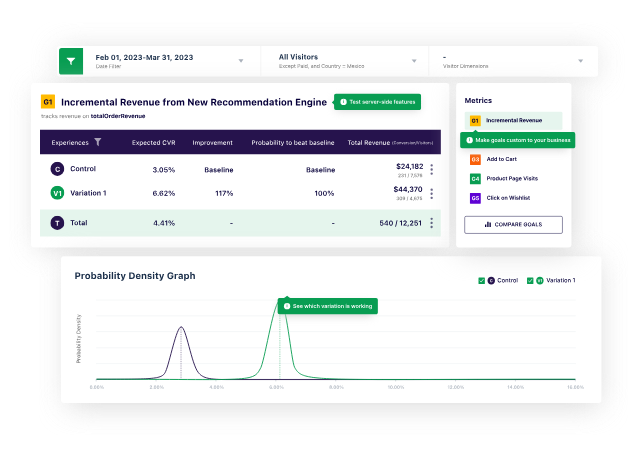
VWO (acquired by AB Tasty) is a digital optimization platform that aims to maximize conversion with tools like A/B testing, personalization, funnels, heatmaps, session replay, and customer analytics. The platform is home to multiple different products including testing, insights, data, personalize, plan, and web rollouts.
Key features
A/B testing: Improve conversion with web, mobile, and server-side A/B testing.
Data platform: Collect and analyze custom data across your stack.
Insights: Understand your users with session recordings, heatmaps, analytics, and surveys.
Personalization: Create and tailor user journeys and campaigns to the audience, location, and time.
Planning: Ideate and plan optimization campaigns in one location.
How does VWO compare to Statsig?
VWO is closer to Optimizely than Statsig, though it offers most of the same features. It doesn't offer a complete product analytics tool, but it does offer basic funnel analysis, heatmaps, session replays, and user surveys as part of its wider platform. Unfortunately, many of these features are only available on their more expensive plans.
Note: Private equity firm Everstone Capital acquired a majority stake in VWO in January 2025. In January 2026, Everstone announced that VWO would merge with AB Tasty, combining into a single digital experience optimization platform.
Main differences between VWO and Statsig
- VWO is built around AI-assisted CRO for marketers. Statsig has been adding AI features, but its center of gravity is still server-side experimentation for engineers.
- Statsig includes deeper product analytics and warehouse-native experimentation; VWO offers only basic funnel analysis.
- Many of VWO's insights features are gated behind higher-priced plans; Statsig bundles more into its core offering.
- Both are now part of larger entities.
Main similarities between VWO and Statsig
- Both offer A/B testing with secondary metrics and multivariate support.
- Both ship an MCP server so AI agents can run experiments and manage flags directly.
- Both provide some level of session replay and behavioral insights.
- Both are usage-based rather than seat-priced.
Why do companies use VWO?
Based on G2 reviews, the biggest reasons to choose VWO are:
Support: VWO's support staff are knowledgeable, helpful, and responsive. This helps people get the most out of the platform from onboarding onwards.
Multi-use: Reviewers like that they can combine A/B tests with surveys, funnels, session replays, and analysis tools to optimize the complete user experience.
Data-focused: VWO enables both technical and non-technical users to make better data-driven decisions by being the complete source of experience data.
Bottom line
Like Optimizely, VWO is a good alternative to Statsig if you're looking for a tool anyone in your company can use. It offers a no code editor for marketing experiments, while also offering tools like heatmaps and replays that are useful for non-engineers.
6. GrowthBook
- Founded: 2020
- Similar to: LaunchDarkly, Statsig
- Typical users: Engineers and data scientists
What is GrowthBook?
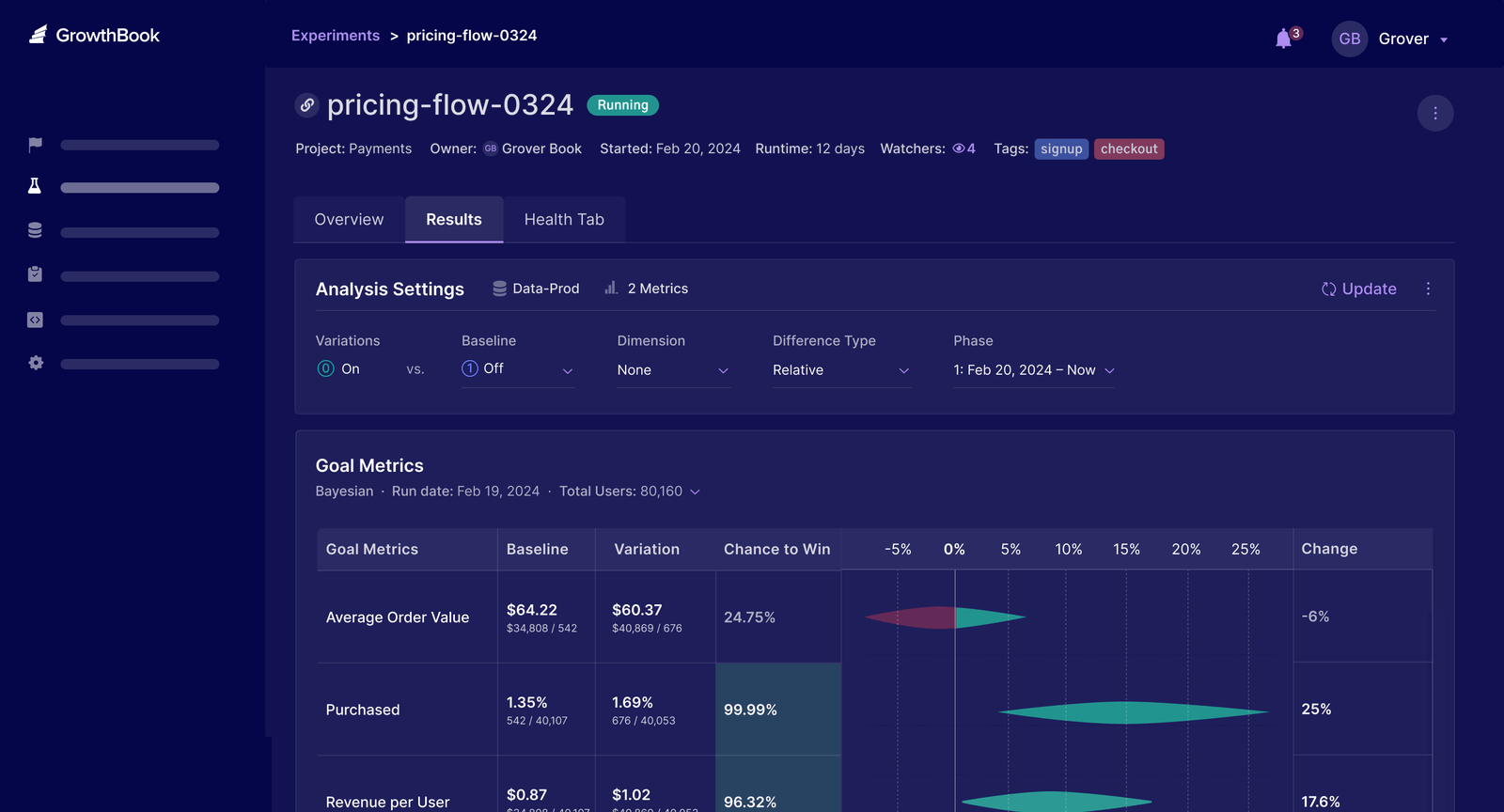
GrowthBook is a warehouse-native feature flag and experimentation platform. Its biggest selling point is integrating with the product and data tools you already use.
It's a popular choice for companies in strict regulatory environments because it is warehouse-native and self-hostable, but you can also use its hosted cloud version.
Key features
Warehouse-native: Designed to integrate seamlessly with your existing data tools like Snowflake or Postgres.
Feature flags: Robust feature-flagging capabilities with custom targeting and scheduling.
A/B testing: Experimentation suite built on feature flags with a visual editor to optimize UI changes.
Analysis: Use either Bayesian or Frequentist engines. Connect your existing data and do retroactive analysis.
Integrations: Connects with data warehouses and analytics tools, but has limited integrations beyond that.
How does GrowthBook compare to Statsig?
GrowthBook is a much more focused tool than others on this list. It is primarily a feature flag and experimentation platform, with a visual experiment editor that enables non-engineers to run simple web experiments. Its big differentiator is that it is open source and self-hostable.
Main differences between GrowthBook and Statsig
- GrowthBook appeals to regulated and privacy-sensitive companies thanks to self-hosting; Statsig is primarily cloud. - GrowthBook is warehouse-native by design, running analysis on your own data; Statsig offers a warehouse-native mode but also has its own hosted analytics. - Statsig includes session replay and broader product analytics; GrowthBook focuses on flags and experimentation.Main similarities between GrowthBook and Statsig
- Both ship advanced statistical methods like CUPED variance reduction, sequential testing, Bayesian and Frequentist engines, and multi-armed bandits. - Both can connect to and analyze data in your warehouse. - Both are built for engineers and data scientists.Why do companies use GrowthBook?
According to G2, reviewers choose GrowthBook for the following reasons:
Warehouse-native: GrowthBook's integrations with the warehouses people are already using is a standout feature. It enables them to extract and make use of the data they already have.
Visual editor: The visual A/B test editor and experiment preview enable non-technical users to make full use of GrowthBook.
Self-hostable: Reviewers like that they have full control over GrowthBook by running it on their own infrastructure. This means no limits to data.
Bottom line
Being open source, free, and self-hostable, GrowthBook makes for a good alternative to Statsig, especially for companies in tricky regulatory situations.
7. Kameleoon
- Founded: 2012
- Similar to: LaunchDarkly, VWO
- Typical users: Product managers and developers

What is Kameleoon?
Kameleoon is a developer-focused complete optimization platform with A/B testing, feature management, and personalization. On top of these, it includes an AI copilot that helps generate options, do predictive targeting, assist in decisions, and more.
Key features
Web experimentation: Use their smart graphic editor and widget library to run flicker-free A/B tests on your website.
Feature experimentation: Do targeted rollouts of features and analyze their impact.
AI copilot: Have AI help with targeting, decision-making, and experiment creation.
Stats accuracy: Provides advanced stats like sample mismatch ratio, cross-campaign analysis, CUPED, and multiple test correlation.
How does Kameleoon compare to Statsig?
Like Statsig, Kameleoon is an A/B testing platform first and foremost, though it hasn't branched into other arenas, like analytics. Its AI copilot feature is a major differentiator, while it can be self-hosted if this is a requirement for your business.
Main differences between Kameleoon and Statsig
- Kameleoon can be self-hosted for businesses that require it; Statsig is primarily cloud. - Kameleoon is HIPAA, GDPR, and CCPA compliant and has invested in regulated-industry features; Statsig is hosted in the US and relies on the EU-US Data Privacy Framework for European data, which makes it a tougher fit for healthcare, banking, or insurance. - Statsig includes built-in product analytics and session replay; Kameleoon focuses on experimentation and personalization rather than analytics.Main similarities between Kameleoon and Statsig
- Both provide advanced statistical methods like CUPED, sequential testing, Bayesian and Frequentist engines, and Sample Ratio Mismatch detection. - Both support hybrid client-side and server-side experimentation. - Both provide native two-way integrations with data warehouses, CDPs, and analytics platforms. - Both serve product managers and developers.Why do companies use Kameleoon?
According to G2 reviews, users are big fans of the following aspects of Kameleoon:
Statistical tools: Reviewers are more confident about the results of their experiments thanks to Kameleoon's different statistical engines and AI copilot.
Editors: The combination of the graphics and widget editors makes it easy to set up A/B tests and personalizations.
Integrations: Reviewers like how Kameleoon integrates with all the tools they already use, like Google Analytics, Adobe Analytics, and Mixpanel.
Bottom line
For companies looking for a developer-focused optimization platform, Kameleoon is a good alternative. Though the lack of self-serve is a major downside.
Which Statsig alternative should you choose?
- Want an all-in-one developer platform with analytics, feature flags, experiments, session replay, surveys, and more – plus a powerful MCP server that spans the whole platform? Go with PostHog.
- Need enterprise-grade feature management with governance, automation, and auditability? LaunchDarkly is built for that.
- Want deep product analytics with experimentation for product and marketing teams? Amplitude skews enterprise.
- Marketing or frontend team needing a no-code visual editor and CMS/ecommerce tools? Optimizely is the go-to.
- Conversion-focused team wanting heatmaps, personalization, and a visual editor? VWO specializes here (now merging with AB Tasty).
- Data scientists wanting warehouse-native, open-source, self-hostable experimentation? GrowthBook fits.
- Developer-focused optimization with an AI copilot and strong personalization? Kameleoon is worth a look.
Is PostHog right for you?
Here's the (short) sales pitch.
We're biased, obviously, but we think PostHog is the perfect Statsig replacement if:
- You value transparency. We're open source and open core.
- You want more than just A/B testing and feature flags. We have a full suite of product analytics, session replays, surveys, error tracking, and more.
- You want to try before you buy. We're self-serve with a generous free tier.
It's completely free to get started – no credit card required. Our setup wizard handles configuration in minutes, or you can check out our product pages and read our docs to learn more.
Install PostHog with one command
Paste this into your terminal and make AI do all the work.
Frequently asked questions
Why look for Statsig alternatives?
Common reasons include: wanting deeper product analytics, needing other tools Statsig doesn't offer, preferring an open-source or independent platform, or wanting to consolidate experimentation with the rest of your product stack.
What's the cheapest Statsig alternative?
It depends on whether you're comparing free tiers, paid plans, or total cost of ownership – and how your team is shaped.
For free-tier usage, Statsig itself is hard to beat: 2M events, 50K session replays, and unlimited seats for $0. PostHog is the most competitive alternative at this level – 1M events, 5,000 web replays + 2,500 mobile replays, 1M flag requests, and unlimited team members on the free tier, plus $50k in additional credits for eligible startups. GrowthBook's free Starter plan also covers unlimited flags and unlimited users on both cloud and self-hosted.
For paid usage, GrowthBook self-hosted has no per-seat fees, which makes it the cheapest option at scale for teams comfortable running their own deployment. PostHog uses transparent usage-based pricing with a public calculator.
For teams of 10+ where seat math matters, PostHog and Statsig are usually cheaper than LaunchDarkly, which charges per seat from its Starter plan. GrowthBook is seat-priced too, but with a more accessible free tier.
If minimizing spend is the goal and you can host it, GrowthBook self-hosted wins. If you want a fully managed platform with the broadest feature set per dollar, PostHog is usually the strongest fit.
What's the best Statsig alternative overall?
For most teams, PostHog is the best all-around Statsig alternative. It combines feature flags and A/B testing with product analytics, session replay, AI observability, logs, surveys, error tracking, and more – all open source, independent, and with a generous free tier.
Which Statsig alternatives are open source?
PostHog is fully open source under the MIT license with a public roadmap. GrowthBook is also open source and self-hostable. Most other alternatives – LaunchDarkly, Amplitude, Optimizely, VWO, and Kameleoon – are proprietary.
Which Statsig alternative is best for feature flags?
LaunchDarkly is the most established enterprise feature management platform, with deep governance and automation.
PostHog offers feature flags with local evaluation, JSON payloads, and instant rollbacks, tightly integrated with analytics and experiments so you can measure impact in one place.
Which Statsig alternative is best for experimentation?
PostHog is ideal if you want experimentation tightly integrated with the rest of your product stack, so you can instantly see how experiments impact funnels, replays, and error rates.
For marketing-led, no-code web experimentation, Optimizely, VWO, and Kameleoon offer visual editors.
GrowthBook is the pick if you want warehouse-native, self-hostable experiment analysis.
Which Statsig alternative is best for no-code experiments?
Optimizely, VWO, and Kameleoon all offer no-code visual editors that let marketing teams run web experiments without engineering. VWO and Kameleoon add personalization and heatmaps, while Optimizely bundles content management and ecommerce tooling.
What other experimentation and feature flag tools are available?
Beyond the tools in this guide, there are many other options worth considering.
See our comparisons of the best LaunchDarkly alternatives, best Optimizely alternatives, and best VWO alternatives for broader coverage.

Subscribe to our newsletter
Product for Engineers
Read by 100,000+ founders and builders
We'll share your email with Substack
PostHog is an all-in-one developer platform for building successful products. We provide product analytics, web analytics, session replay, error tracking, feature flags, experiments, surveys, AI Observability, logs, workflows, endpoints, data warehouse, CDP, and an AI product assistant to help debug your code, ship features faster, and keep all your usage and customer data in one stack.